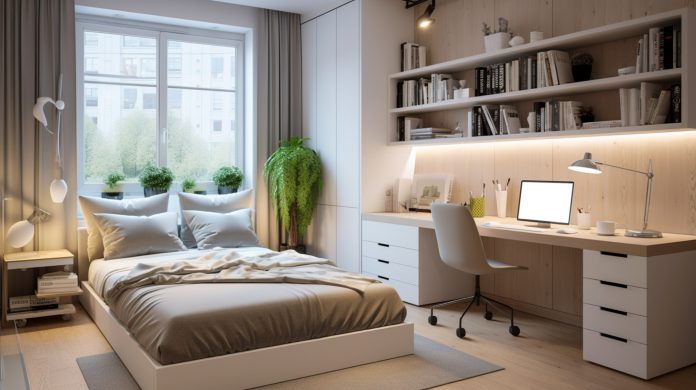
The Room Where Every Inch Matters
A small bedroom — under 150 square feet, often a secondary bedroom in an older home or a primary bedroom in a compact apartment — presents the furniture challenge of accommodating the necessary functions of a bedroom (sleeping, dressing, storage) in a footprint that doesn’t allow the conventional dresser-nightstands-bed arrangement without creating a room that feels like a furniture showroom rather than a livable space.
The bedroom furniture solutions that work in small rooms are specific and sometimes counterintuitive: certain pieces that feel appropriately scaled in a larger room overwhelm a small one, and pieces that seem unconventionally sized actually work better in compact bedrooms than their standard equivalents.
Bed Selection: The Platform Advantage
A platform bed (a low-profile frame with no footboard or a minimal one, and a headboard that doesn’t extend significantly above pillow height) reads as less visually heavy in a small bedroom than a traditional bed with substantial head and footboard. The lower visual profile makes the ceiling feel higher and the room feel less dominated by the largest piece of furniture.
The platform bed’s storage potential transforms it from a visual improvement to a functional one: platform beds with built-in drawers (typically 2–4 drawers on each side of the bed) replace the dresser entirely in small bedrooms where floor space for a separate storage piece isn’t available. The under-bed storage in a quality storage bed is equivalent to a medium-sized dresser — enough for folded clothing, seasonal items, and bedding.
The Floating Nightstand: Floor Space Recovery
Wall-mounted floating nightstands (shelves mounted at bedside height in place of freestanding nightstand tables) eliminate the floor footprint of conventional nightstands while providing the surface for a lamp, a book, and the phone charging that nightstands serve. The floor beneath the floating shelf remains clear, making the room feel larger and making cleaning easier.
Floating shelf nightstands can be positioned at exactly the height that works for the specific bed height rather than being limited to the heights available in production nightstand designs. The installation requires stud mounting or wall anchors rated for the weight the shelf will hold — a lamp, a book, and a glass of water at most, which is within the range of most wall anchor systems.
The Wardrobe as a Dresser Alternative
In bedrooms without adequate closet space for a full wardrobe organization, a freestanding wardrobe (armoire) provides hanging storage, shelf storage, and in some designs drawers — all in a smaller floor footprint than the equivalent separate pieces. A 36-inch wide wardrobe with interior hanging rod, shelf, and two drawers replaces a closet section plus a dresser in the space of one piece.
The visual impact of a wardrobe: it’s tall and therefore visually heavy in a small room, but its enclosed nature (doors that conceal contents) creates less visual clutter than open shelving with the same storage volume. In a small bedroom, the wardrobe’s height actually works in its favor — it draws the eye up and makes the ceiling feel higher relative to the furniture.
The Multi-Function Ottoman and Bench
The foot-of-bed bench or ottoman with interior storage — a hinged-top bench that provides seating for dressing and storage for bedding, seasonal clothing, or workout gear inside — adds a function without adding floor footprint in a location (the foot of the bed) that would otherwise be empty floor. In a small bedroom, every piece of furniture should ideally serve at least two functions; the storage bench serves three: seating, storage, and the visual grounding of the bed in the room.