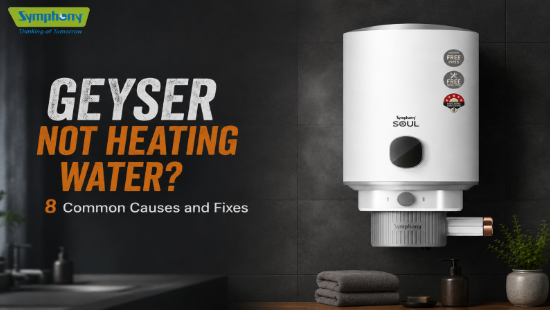
In case your geyser has been functioning for quite a while but the water is still coming out chillingly cold. This is where you do not have to assume the worst, such as that anything major has failed.
Check the power switch first. Then look at the indicator light and the MCB to see if anything has tripped. It is also a good idea to check whether water is flowing as usual.
If all of these seem fine, the trouble may be somewhere inside the geyser. A damaged heating element or thermostat is one possibility.
In such a situation, switch off the geyser and allow a technician to scan it. Avoid opening the unit, especially when the electrical parts are in the equation.
What are the Reasons for My Geyser Not to Heat Water?
Cold water does not always mean the whole geyser has failed. Often, one part is stopping the heating process. What the geyser does – or doesn’t do – can give you a useful clue.
-
Is the Indicator Light Off?
Begin with the power supply.
Check the wall switch. Then look at the indicator on the geyser. In case there is no sign of power, assess the MCB or circuit breaker. You can even start by scrutinizing whether the power supply is switched on when a water geyser does not heat the water.
You can reset a tripped breaker once. If it trips again after switching on the geyser, leave the appliance off and get it checked. Don’t keep resetting it and hoping the problem will disappear.
This simple check may save you from assuming that your electric water geyser needs a new part when the real issue is with the power supply.
-
Can the Heating Element Stop Working?
Yes. The heating element has one important job. It produces the heat that warms the water.
When the element fails, the geyser may still appear to have power, but the water can remain cold. At other times, the change is less sudden. The geyser functions well; however, you are left waiting for a pretty long time for water to heat up.
It is a remote possibility for the hard water deposits to accumulate around the heating element, which can affect the performance of heating. Check and descale heating elements where mineral buildup is an issue.
Symphony’s Swish 3 L instant electric geyser, for example, uses a 3000 W copper heating element. If the element needs testing or replacement, call a technician.
-
Is the Temperature Setting Too Low?
The thermostat helps control the water temperature. So, before thinking about a major repair, check the temperature control if your model has one that is meant for everyday adjustment.
A setting that is too low can leave you wondering why the water never feels properly hot. Symphony also lists thermostat adjustment as a basic check when geyser water is too hot or too cold.
If the setting looks right but the water temperature still keeps changing, the thermostat itself may need testing. Don’t remove the geyser cover to reach internal electrical controls. Let a technician handle that part.
-
Why Did the Geyser Stop Heating Suddenly?
A safety feature may have switched the heating off. Several electric geysers make use of a thermal cut-out to shield against a massive rise in temperature. In case it keeps getting triggered, never try to bypass it. The reason matters more than getting the geyser running for another bath.
The Symphony Swish 3 L has an ISI-marked thermostat along with a preset thermal cutout. It also uses a colour-changing LED to show the heating status. If the safety system repeatedly stops heating, get the cause checked.
-
Can Hard Water Make a Geyser Heat Slowly?
Yes, and this problem may creep up on you.
-
Has Scale Built Up Inside?
Think about the white layer you sometimes see around a tap in a hard-water area. Minerals can collect inside the geyser too. As deposits build around the heating element, heat does not transfer as effectively as before.
A storage water geyser may then require more time to heat when it comes to its tank. Hard water can result in limescale accumulation and a reduction in performance of the heater. To maintain it optimally, you should carry out regular descaling and inspection.
So, if the geyser was quick six months ago but now keeps you waiting, scale could be part of the problem. Turning the temperature higher won’t remove it.
-
Could Loose Wiring Stop the Heating?
It could. A geyser can have power at the switch while a damaged or loose electrical connection prevents normal heating.
Pay attention to odd behaviour. Maybe the indicator flickers. Perhaps the switch feels unusually hot. The geyser may work one day and refuse to heat the next. A burning smell is another reason to stop using it immediately.
Switch the appliance off and get the electrical connection inspected. Opening a bathroom appliance and looking around for a loose wire is not a safe DIY repair.
-
Does Water Flow Affect an Instant Geyser?
Yes. It matters more with an instant model because water is being heated as you need it.
9. Has the Water Flow Changed?
Start with something easy. Make sure the inlet valve is properly open. Next, contemplate the fact that the water pressure in your bathroom has changed all of a sudden. The Swish 3 L is rated for pressure up to 0.65 MPa, or 6.5 bar. This pressure rating is suitable for apartment use.
Can an Old Geyser Lose Heating Performance?
Of course. A geyser works regularly in most homes, and its parts don’t stay new forever.
-
Are Worn Parts Causing Repeat Problems?
Heating elements wear. Thermostats can fail. Electrical connections can develop trouble. Hard-water deposits may also build over the years. One repair doesn’t mean the geyser should be thrown away. Five repairs are a different conversation.
In case you are spending money on the same appliances every now and then, have a comparison done for those bills with the replacement cost. While you are doing the computation, evaluate whether the capacity of your old geyser still matches the requirements of your family.
For example, someone researching the 10 litre geyser price can currently find Symphony’s Soul 10 L model listed at ₹9,491. The Soul range is also offered in 15 L and 25 L capacities. Prices and online offers may change.
Which Geyser Is Better for a Bathroom?
There isn’t one best water geyser for every home. What matters is how you actually use hot water.
-
Would an Instant Geyser Suit You?
An electric geyser for bathroom use can be handy when you want a smaller quantity of hot water quickly. Take Symphony’s Swish 3 L. It has a stainless-steel tank, 3000 W copper heating element, thermostat, preset thermal cut-out, and LED heating indication.
At the time of writing this piece of content, the Swish 3 L costs ₹3,691 against the original MRP of ₹5,999. This price can alter depending on when you are browsing the product page on the Symphony website.
-
Would a Storage Geyser Suit You Better?
A bathroom water geyser with storage may be more comfortable when several people need hot water one after another. Symphony’s Soul range comes in 10 L, 15 L, and 25 L options.
When you opt for a geyser for bathroom use, never solely look at the price or capacity alone. Also, consider the number of users, the available space, water pressure, and bathing habits. Also, contemplate over the fact that hard water is commonly found in your area or not.
Final Thoughts
You can check the switch, MCB, indicator light, water flow, and any temperature control designed for normal user adjustment. After this, know where to stop.
Contact a technician and ask them to start with the obvious checks rather than guessing. A small observation – no indicator light, slower heating, changing water temperature, or repeated tripping – can tell you a lot about what might be wrong.
And it can help the technician find the actual problem without unsafe trial and error.